PROSPECTS OF FARMING ARCTIC CHARR (SALVELINUS ALPINUS L.)
Introduction
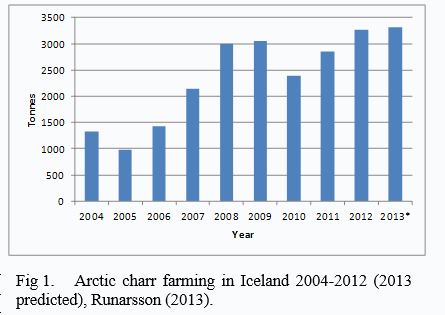
The global annual production of Arctic charr in aquaculture is approximately six thousand tonnes with Iceland as the biggest producer with 3.300 tonnes, Runarsson (2013). Arctic charr is a high quality salmonid species, breed at relatively high densities (Brown et al., 1992; Christiansen et al., 1992; Jörgensen et al., 1993; Brännäs and Linner, 2000; Gunnarsson, 2006; Oddsson and Steindorsson, 2009; Dalsgaard et al., 2012), with high fillet yields (55-57%) (Glandfeldt, 1993; Gunnarsson et al., 2011). Successful breeding programmes have been carried out in Iceland and Sweden and the interest for landbased farming of Arctic charr is increasing. The small production volume provides a challenge in marketing this high quality product as it is unknown to many market areas and several small operations need to supply the markets on a steady basis. Nevertheless, the market price of fresh Arctic charr has reached more than twice the market price of Atlantic salmon showing the high quality and consumer preferences in markets where the species is well known. Certification of Arctic charr as sustainable produced or as an organic salmonid may further improve the marketing opportunities.
Arctic charr farming
Arctic charr is farmed in Iceland, Canada, Sweden , Norway , Finland , Estonia, West Virginia and Ireland . Iceland is the main producing country with more than half of the production. Fig. 1. shows the annual farming of Arctic charr in Iceland from 2004-2012 (2013 predicted), Runarsson, 2013.
Arctic charr are tolerant of high stocking densities and that make them an ideal candidate for landbased farming (Wallace et al., 1988; Brown et al., 1992; Christiansen et al., 1992; Jörgensen et al., 1993; Metusalach et al., 1997; Brännäs and Linnér, 2000). When water quality is secured there is no evidence of decreased growth rate at densities between 40 and 100 kg m-3 suggesting that the fish are not stressed.
Marketing Arctic charr
Arctic charr is not a well known species outside the Nordic countries and Alpine regions and this requires a different approach to marketing than for other salmonid species such as Atlantic salmon and rainbow trout. Since the production of Arctic charr is still modest, the main competition faced by Arctic charr farmers is not from other charr producers but rather from Atlantic salmon and rainbow trout. The cost of production of Arctic charr is higher than for the other two species and, therefore, the market price for Arctic charr must be higher if the aquaculture is to be successful.
Discussion and conclusion
The largest markets for Arctic charr in Europe are in the Nordic countries, UK, Germany and Switzerland. Increased production will strengthen the overall Arctic charr market as the main marketing challenges today are the small production volumes. As Arctic charr becomes better known the market demand will expand. Increased production works towards strengthening the marketing work and improving steady basis market supplies. Moreover, there are unexploited market opportunities for certified sustainable produced and/or organic Arctic charr.
References
Brännäs, E. & Linnér, J. (2000). Growth effects in Arctic charr reared in cold water: Feed frequency, access to bottom feeding and stocking density. Aquaculture International 8: 381-389
Brown, G. E., Brown, J. A. and Srivastava, R. K. (1992), The effect of stocking density on the behaviour of Arctic charr (Salvelinus alpinus L.). Journal of Fish Biology, 41: 955-963. doi: 10.1111/j.1095-8649.1992.tb02722.x
Christiansen, J.S., Svendsen, Y.S., Jobling, M. (1992). The combinded effects of stocking density and sustained exercise on the behaviour, food-intake, and growth of juvenile Arctic charr (Salvelinus alpinus L.). Canadian Journal of Zoology 70: 115-122
Dalsgaard, J., Lund, I., Thorarinsdottir, R., Drengstig, A., Arvonen, K., Pedersen, P.B. (2012). Farming different species in RAS in Nordic countries: Current status and future perspectives, Aquacultural Engineering
Glandfeld, R. (1993). Arctic char production in Ontario, in: Proceedings of the Canadian Arctic Char Conference 93-2, St. Andrews, NB, November, 1992, Bulletin of the Aquaculture Association of Canada
Gunnarsson, S., Imsland, A.K., Árnason, J., Gústavsson, A., Arnarson, I., Jónsson, J.K., Foss, A., Stefansson, S., Thorarensen, H. (2011). Effect of rearing temperatures on the growth and maturationof Arctic charr (Salvelinus alpinus) during juvenile and on-growing periods. Aquacult. Res. 42, 221-229
Gunnarsson, V.I. (2006). Staða bleikjueldis á Islandi, samkeppnishæfni og stefnumótun rannsókna- og þróunarstarfs ("in Icelandic"). (The status of aquaculture of Arctic charr in Iceland, competitiveness and R&D strategy). Sjávarútvegurinn, vefrit um sjávarútvegsmál, 2 tbl. 6. Árg., Iceland
Jorgensen, E.H. ; Christiansen, J.S. ; Jobling, M. (1993), Effects of stocking density on food intake, growth performance and oxygen consumption in Arctic charr (Salvelinus alpinus). Aquaculture, Volume 110, issue 2 p. 191-204. ISSN: 0044-8486 DOI: 10.1016/0044-8486(93)90272-Z
Metusalach, J. A. Brown & F. Shahidiu (1997). Effects of stocking density on colour characteristics and deposition of carotenoids in cultured Arctic charr (Salvelinus alpinus). Food Chemistry 59:107-l 14
Oddsson, S., Steindorsson, T. (2009). Staða bleikjueldis og framtíðarhorfur ("in Icelandic": Status and future prospects of Arctic char aquaculture). Ministry of Agriculture and Fisheries, Iceland: http://eur-lex.europa.eu/LexUriServ/LexUriServ.do?uri=OJ:L:2009:204:0015:0034:EN:PDF
Runarsson, G. (2013) Aquaculture in Iceland, presentation 22. april 2013. The Icelandic Aquaculture Association. <http://lfh.is/documents/China23042013.pdf>
Wallace, J.C., Kolbeinshavn, A.G., Reinsnes, T.G. (1988). The effect of stocking density on early growth of Arctic charr, Salvelinus alpines (L.). Aquaculture 73, 101-110