Morphometric and meristic characteristics of a population of Capoeta capoeta (Pisces: Cyprinidae) in the Sefidroud River, from the southern Caspian Sea Basin
Introduction
The study of morphological characters, with the aim of characterizing fish stock units, has for some time been a strong interest in ichthyology (Cardin, 2000). In general, a fish stock is a local population adapted to a particular environment, having differences from other stocks (MacLean and Evans, 1981). The south Caspian Sea River basin encompasses 256,000 km2, 15.5% of the whole country (Zakeri 1997). This basin is located in the European area of the Eurasia (Banarescu & Coad 1991) and is one of the most various freshwater ecosystems in Iran (Coad 1995). One of the important rivers in the southern Caspian basin is the Sefidroud River with 765 km length in this region (Aghili et al., 1999). One of the predominant fish in the river is Siah Mahi, C.capoeta. The genus Capoeta contains potamodromous cyprinid fish and contains about 10 species, of which 7 occur in Iran (Coad, 2005). It is one of the most taxonomically complex genera of the Cyprinidae family (Coad, 1995). This genus inhabiting both lotic and lentic habitats (Samaee et al., 2006). They are also distributed throughout the freshwater river systems of the South Caspian Sea basin (Abdoli et al., 2008; Samaee et al., 2009). In addition to its ecological significance, Capoeta capoeta is an important species harvested for sport and inland water fishing (Kiabi et al., 1999). The morphometric characters between two sexes of Capoeta capoeta did not different (Anvarifar et al., 2011). the propose of this study was the detection of morphometric and meristic characters of Capoeta capoeta populations in the southern Caspian Sea. In particular, the authors wished to determine the differences in morphometry between fish specimens from the regions, and the body-form characteristics that most contribute to this discrimination.
Materials and methods
For the study 40 fish specimens were collected in Sefidroud River (36°77′89″N, 49°15′25″E) in November 2013 by electroshocking with 200-300 V. The sampled fish were fixed in 10% formaldehyde at the sampling site and transported to Laboratory for further studies. In total, 36 morphometric characteristics and 12 meristic characteristics were recorded in each fish specimen after formaldehyde fixation. Morphometric measurements were taken using an electronic digital caliper precise to the nearest 0.01 mm and meristic measurements were examined under the loop. Statistical analyses for morphometric and meristic data were performed using the Excel (Microsoft Office, 2007). Data are presented as mean ± standard deviation (SD).
Results
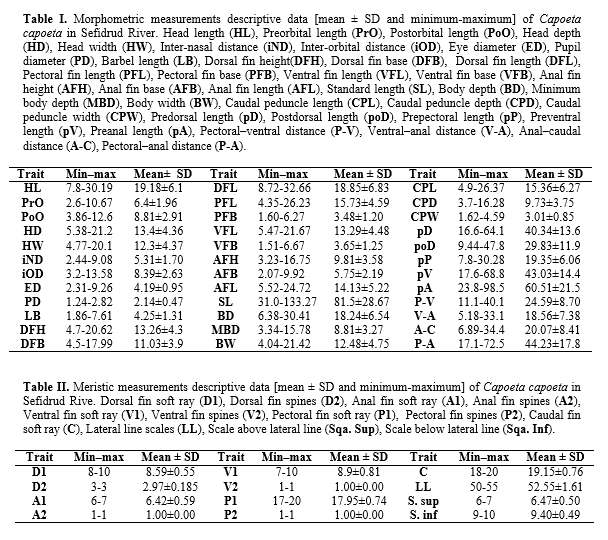
Descriptive data for morphometric and meristic measurements, range (minimum- maximum), mean, standard deviation (SD) in case of sampled specimens are shown in Table 1 and 2.
Discussion
This is the first report on morphometric and meristic characteristics within the Capoeta capoeta population in Sefidroud River. The causes of morphological differences between populations are often quite difficult to explain (Poulet et al., 2004). It has been suggested that the morphological characteristics of fish are determined genetic, environment and the interaction between by them (Swain & Foote, 1999; Poulet et al., 2004; Pinheiro et al., 2005). Also the differentiation detected between populations may result from different environmental and habitat conditions, such as temperature, turbidity, food availability, and water depth and flow (Samaee et al., 2006). The environmental factors prevailing during the early development stages, when the individual's phenotype is more amenable to environmental influence is of particular importance (Pinheiro et al., 2005). The phenotypic variability may not necessarily reflect population differentiation at the molecular level (Ihssen et al., 1981). It is well known that morphological characteristics can show high plasticity in response to differences in environmental conditions (Wimberger, 1992). The considerable differences observed among the river samples of Capoeta capoeta lead us to search for more morphometric characteristics to confirm the differentiation found and to formulate a key for the taxon, which can be easily used in the field by researchers.
This study provides basic information about the morphometric and meristic characteristics of Capoeta capoeta population in Sefidroud River and suggests that morphological variations observed in Capoeta capoeta should be considered in fisheries management and commercial exploitation of this species and any stockenhancement program.
References
- Cardin, S. X., 2000: Advances in morphometric identification of fishery stocks. Rev. Fish Biol. Fish. 10, 91-112.
-Poulet, N., Berrebi, P., Crivelli., Lek, S. & Argilier, C., 2004. Genetic and morphometric variations in the pikeperch (Sander lucioperca L.) of a fragmented delta. Archiv fu¨r Hydrobiologie 159: 531-554.
-Wimberger, P. H., 1992. Plasticity of fish body shape - the effects of diet, development, family and age in two species of Geophagus (Pisces: Cichlidae). Biological Journal of the Linnean Society 45: 197-218.
-Pinheiro, A., Teixeira, C. M., Rego, A. L., Marques J. F. & Cabral H. N., 2005. Genetic and morphological variation of Solealascaris, (Risso, 1810) along the Portuguese coast. Fisheries Research 73: 67-78.
-Ihssen, P. E., Evans, D. O., Christie, W. J., Rechahn, J. A. & DesJardine, D. L., 1981. Life history, morphology, and electrophoretic characteristics of five allopatric stocks of Lake Whitefish (Coregonus clupeaformis) in the Great Lakes region. Canadian Journal of Fisheries and Aquatic Sciences 38: 1790- 1807.