HOW CHANGES IN FATTY ACID COMPOSITION OF FISH FEED INFLUENCES OMEGA-FATTY ACID CONTENT IN CARP MEAT
Introduction
For many years, much attention is given to fish meat and its presence in human nutrition. The reason for that lies in significant amount of polyunsaturated fatty acids (PUFA), particularly omega-3 fatty acids (n-3 FAs) which are present in all types of fishes. They are derived from α-linolenic acid (ALA), which is the precursor of docosahexaenoic (DHA) and eicosapentaenoic (EPA) acids (Gorjão et al, 2009).Carp represents one of the largest groups of cultured fish with around 70% of freshwater aquaculture production. The majority of European carp production is placed in central Europe where it is produced in ponds using traditional semi-intensive techniques. It is traditionally reared in earthen ponds and its nutrition is based on natural food with cereal supplementation (Buchtova et al, 2007). Since cereals are rich in carbohydrates and have very low level of n-3 FA, the flesh of the farmed carps generally contains a high level of oleic acid and low level of favourable n-3 HUFA (Chengeri, 1996). An alternative approach to influence muscle lipid composition might be inclusion of rich sources of omega FA in fish feed. The aim of this study was to examine how addition of linseed oil and fish oil influences FA composition of fish feed, and to register if there are any changes in FA composition of meat of carps fed with experimental diets, with emphasis on omega-FA content.
Material and methods
Carp feeds were formulated according to commercial and physiological concideration. Following ingredients were used for production of basic diet: corn (30%), wheat (10%), corn gluten (10%), fish meal with 70% of protein (10%), soybean meal (36%), yeast (3%), and premix (1%). Experimental diets were prepared by addition of 6% of linseed oil (Diet 1) and 6% of fish oil (Diet 2). Fish feed was produced on twin-screw extruder Mu Yang MY 90, China, with a screw diameter of 85mm, length-to-diameter ratio of 20:1, and maximum temperature of 135°C. Extruder was equipped with diferential diameter conditioner (DDC). Addition of oil was done on laboratory vacuum coater model F-6-RVC, with capacity of 6 l per batch (Forberg International AS, Norway).
Experimental carps were bred in 2.0m3 plastic square-shaped tanks divided into two compartments (about 1.0m3 each), with 12 fishes per compartment. Water inflow into the tanks was regulated to ensure oxygen concentration of the outflow water at least 80% of saturation. Natural day-light regime was ensured and feeding was performed by automatic belt feeders during 10 hours per day.
Fat for FA analyses was extracted from the samples of feed and fish meat using Folch method (Folch et al., 1957). The preparation of FA methyl esters was done by transmetilation that use 14% wt. boron trifluoride/methanol solution, as recommended method for this type of substrates. FA composition analyses were done on a gas chromatographer Agilent 7890A system (Agilent Technologies, CA, USA) with flame ionization detector, and fused silica capillary column (SP-2560, 100 m x 0.25mm, I.D., 0.20µm). Carrier gas was helium (purity > 99.9997 vol%, flow rate = 1.5ml/min).
Results and discussion
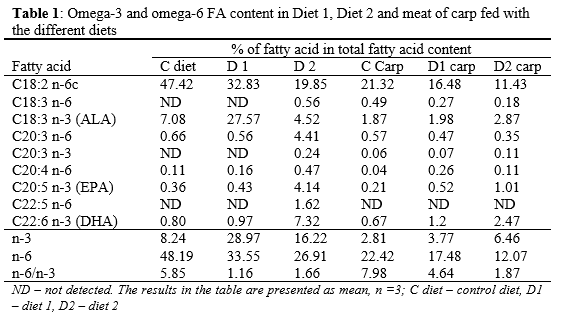
Obtained results are persented in Tale 1. As it can be seen, both experimental diets had significantly (p ≤ 0.05) higher relative content of n-3 FA, while content of n-6 FA decreased. These changes resulted in more favourable n-6/n-3 ratio in comparison with control diet (n-6/n-3 ratio of 5.85), which was 1.16 in Diet 1 and 1.66 in Diet 2. According to WHO and FAO experts, this ratio should be less than 4 (FAO/WHO, 2003). It can be concluded that only control diet did not fulfil this recommendation. Diet 2 showed great increase in EPA and DHA content in comparison with control diet (4.14% and 7.32%, respectively in comparison with 0.36% and 0.80%). Mentioned differences are even more obvious in FA composition of carp meat. Both groups fed with experimental diets had better n-6/n-3 ratio than control group, and carps fed with Diet 2 showed the best results with n-6/n-3 ratio of 1.87. In this sample, EPA content increased almost five times in comparison with control group (1.01% vs. 0.21%), while DHA content increased more than 3.5 times (2.47% vs. 0.67%). EPA content in meat of carp fed with Diet 1 increased to 0.52% and DHA content increased to 1.2%. It can be concluded that addition of fish oil in fish feed gave more favourable FA composition of carp meat than addition of linseed oil.
Conclusion
Based on experimental result, it can be concluded that fish feed significantly influenced FA composition of carp meat. By addition of linseed oil and fish oil in the diet, n-3 FA content of carp meat increased for 0.96 % and 3.65 %, respectively. n-6/n-3 ratio was the most favourable in meat of carp fed with Diet 2, and it was 1.87. It is obvious that both linseed oil and fish oil were proven as a good source of omega-FA in carp feed, but addition of fish oil gave slightly better results.
References
Buchtova, H., Svobodova, Z., Kocour, M., and Velisek. J. 2007. Amino acid composition of edible parts of three-year-old experimental scaly crossbreds of common carp (Cyprinus carpio. Linnaeus 1758). Aquaculture Research 38: 625-634.
Csengeri, I. 1996. Dietary effects on fatty acid metabolism of common carp, Archives of Animal Nutrition 49(1): 73-92.
Folch, J., Lee, M., and Sloane Stanley. G. H. 1957. A simple method for isolation and purification of total lipids from animal tissue. J. Biol. Chem. 226: 497-509.
Gorjão, R., Azevedo-Martins, A. K., Rodrigues, H. G., Abdulkader, F., Arcisio-Miranda, M., Procopio, J., and Curi, R. 2009. Comparative Effects of DHA and EPA on Cell Function, Pharmacology and Therapeutics 122 (1): 56-64.
Diet nutrition and the prevention of chronic diseases. Report of the WHO/FAO Joint Expert Consultation. WHO. Technical Report Series 916. 2003.
Acknowledgement
The experimental work represented in this paper is a part of Integrated and Interdisciplinary Research Project funded by Serbian Ministry of Education and Science, No. of the Project: III 46012.