The effect of semen cryopreservation with the use of glucose-methanol extender on sperm motility parameters and reproductive success of sex-reversed female rainbow trout
G.J. Dietrich1*, J. Nynca1, S. Dobosz2, T. Zalewski2, E. Liszewska1, A. Ciereszko1
1Institute of Animal Reproduction and Food Research, Polish Academy of Sciences in Olsztyn, Poland
2Inland Fisheries Institute, Department of Salmonid Research, Rutki 83-330 Żukowo, Poland
E-mail: g.dietrich@pan.olsztyn.pl <mailto:g.dietrich@pan.olsztyn.pl>
Introduction
All-female rainbow trout populations are desirable for aquaculture, since females reach their commercial size before becoming sexually matured and therefore food is used only for somatic growth. It is achieved by fertilizing eggs with homogametic sperm from sex-reversed females. Sex-reversed females usually lack spermatic ducts and therefore it is necessary to sacrifice the fish in order to collect semen. The development of semen cryopreservation techniques would facilitate artificial fertilization and reduce the stock of sex-reversed females maintained at fish farms. Recently, a simple and effective cryopreservation procedure with the use of glucose-methanol extender was established for rainbow trout semen (Ciereszko et al., 2014). The aim of this study was to test the usefulness of this procedure for the cryopreservation of semen of sex-reversed female rainbow trout.
Material and Methods
The cryopreservation followed the procedure as previously described (Ciereszko et al., 2014). Testicular semen was cryopreserved in 0.25-ml straws after 15 min equilibration in 0.18M glucose and 9% methanol extender at a ratio of 1:9 (semen: extender). The motility and viability parameters were examined for the fresh, equilibrated and frozen-thawed sperm of sex-reversed females (n=9). The eggs were fertilized with thawed semen with spermatozoa to egg ratios 500 000 and 1 000 000. The excess fresh semen (50 μl) combined from three males was used as control of eggs quality. The fertilization success was established by calculating the percentage of embryos at the eyed stage. The sperm viability of frozen/thawed spermatozoa was assessed by flow cytometry after staining with SYBR-14/PI. Data were subjected to repeated measures one-way ANOVA followed by Tukey's post hoc test. The sperm fertilizing ability at different sperm-to-egg ratios was compared using paired t-test.
Results
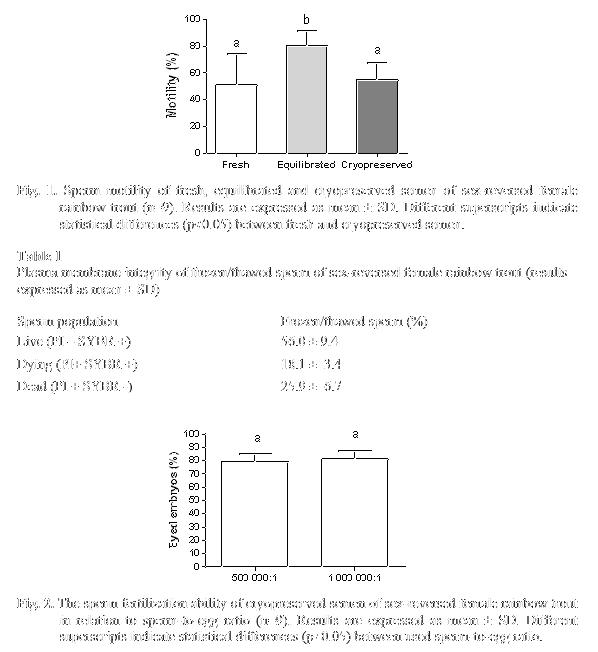
The application of the cryopreservation procedure resulted in remarkably high post-thaw sperm motility (55%; Fig. 1) and viability (Tab. 1). The fertilization success of cryopreserved semen was about 80% for both 500 000:1 and 1 000 000:1 sperm-to-egg ratio (Fig. 2) and was similar to that of fresh semen.
Discussion and conclusion
Our results for the first time show that the post-thaw fertilization ability of rainbow trout sex-reversed females semen can be similar to that of fresh semen at a sperm-to-egg ratio as low as 500 000:1. The cryopreservation procedure using glucose-methanol extender after scaling up can be recommended for routine hatchery practice.
Acknowledgements
This work was supported by Iuventus grant IP2011 0390 71 from Polish Ministry of Higher Education, funds of the National Science Centre granted on research project 2011/01/D/NZ9/03738, and funds appropriated to the Institute of Animal Reproduction and Food Research, Polish Academy of Sciences.
References
Ciereszko A., Dietrich G.J., Nynca J., Dobosz S., Zalewski T. 2014. Cryopreservation of rainbow trout semen using a glucose-methanol extender. Aquaculture 420-421: 275-281.