EVALUATION OF THE ENVIRONMENTAL SUSTAINABILITY OF AQUACULTURE PRODUCTS USING THE "SENSE-TOOL"
Introduction
Food production and consumption cause significant strain on the environment as it is estimated that 29% of global emissions of greenhouse gases (GHG) are from agriculture and food production. In the EU, food consumption accounts for 20-30% of various environmental impacts and, in the case of eutrophication, more than 50% (Tukker et al., 2005).
The food and drink industry in Europe, of which 99% are small and medium enterprises, is highly fragmented, and food chains are normally very complex. Hence, to assess the environmental sustainability of a product there is a need for applying integrated, harmonised and scientifically robust methodologies, together with appropriate communication strategies for making environmental sustainability understandable to the market.
Nowadays the calculation of the potential environmental impact of aquaculture products can lead to benefits to the industries which, in most cases, can lead to brand differentiation. However, most of the industries in this sector, especially SMEs, neither have a strong background nor the capability to assess the sustainability of their products.
Within this framework the SENSE project will deliver a harmonised system for the environmental impact assessment of food and drink products. Existing relevant environmental impact assessment methodologies are applied, and social aspects considered, to deliver a new integral system that can be linked to monitoring and traceability data. In this study the SENSE system will be tested by companies in the aquaculture sector in order to assess the usefulness of the system for the supply chains of aquaculture products.
The research leading to these results has received funding from the European Union's Seventh Framework Programme under grant agreement no. 288974, SENSE- Harmonized Environmental Sustainability in the European Food & Drink Chain.
Project website: <http://www.senseproject.eu/>
Material and methods
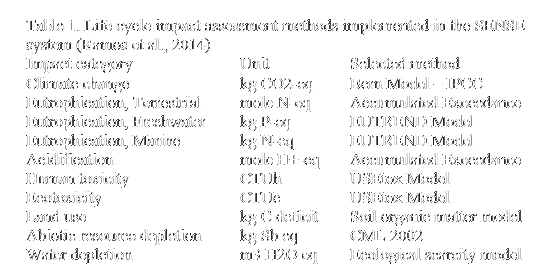
For the development of the tool a set of consistent environmental impact indicators and methods for any food chain has been selected (Table 1).
Moreover, the tool has been developed taking into account the variability of the food and drink sector, involving different type of processes: agriculture, fishing, aquaculture, livestock, industrial production and transporting. For each process relevant input and outputs have been considered for the environmental evaluation. In order to test the validity of the tool in the aquaculture sector, relevant companies have been selected covering all the supply chain steps, from the sourcing of feed and hatchery production, to the commercialisation to consumers or the catering sector.
Results
The main results of simplified environmental assessments will be presented for two different aquaculture producers representing two supply chains from fresh water and salt water production of rainbow trout (Oncorhynchus mykiss).
Discussion and conclusion
This study concluded that the tool is valid to evaluate the environmental impact of aquaculture products in a simplified way. Moreover, according to the company's comments the option of communicating the impact and to make a kind of environmental or green-benchmarking is a very interesting opportunity to add value to their products. However, to ensure the significance of the benchmarking results, more studies are needed in order to obtain representative average values.
References
Ramos, S., Larrinaga. L., Albinarrate, U., Jungbluth. N., Doublet, G., Ingolfsdottir, G. M., Yngvadottir, E., Landquist, B., Aronsson, A., Olafsdottir, G., Esturo, A. and Perez-Villareal, B. (2014b) SENSE tool: Easy-to-use web-base tool to calculate food product environmental impact. In: 9th International LCA of Food 8-10 October 2014, San Fransisco, USA
Tukker, A., Huppes, G., Guine´e, J., Heijungs, R., de Koning, A., van Oers, L., Suh, S., Geerken, T., Van Holderbeke, M., Jansen, B., Nielsen, P., 2005. Environmental Impact of Products (EIPRO). Analysis of the Life Cycle Environmental Impacts Related to the Total Final Consumption of the EU25. Full Draft Report. Institute for Prospective Technological Studies (IPTS), 29 April 2005, 117 pp.