GILTHEAD SEA BREAM (SPARUS AURATA) AND SEA BASS (DICENTRARCHUS LABRAX) PROTEIN AND LIPID DIGESTIBILITY FED WITH ORGANIC AND NON-ORGANIC COMMERCIAL FEED. EVALUATION OF TWO INERT MARKERS IN DIGESTIBILITY STUDIES.
Introduction
There is an increasing social demand of organic products that has determined the development of organic aquaculture. The immaturity of this activity involves an important knowledge gap about the fish digestibility and utilization of organic feed. Likewise, there are many studies that have evaluated the nutrient digestibility of experimental diets (Morales et al., 1999) but only a few that determine the digestibility of commercial feed as it is available for fish farmers (Hillestad et al., 1999; Krontveit et al., 2014). A correct assessment of the commercial feed digestibility involves the use of internal inert markers, since the addition of an external marker could modify the nutritional characteristics of the feed. However there is not fixed criterion for marker choice (Hillestad et al., 1999). This study evaluates the ability of acid insoluble ash (AIA) and crude fiber (CF) as inert internal markers to determine the protein and lipid digestibility in gilthead sea bream (GHSB) and sea bass (SB). We compare the proteins and lipids digestibility in two different commercial gamma feeds, an organic (O+) and a non-organic (O-) ones in three GHSB and SB fish sizes.
Material and methods
Digestibility experiments were carried out in 600l conical tanks with a purge system for the collection of wastes. GHSB and SB of three different sizes (30, 150, 350 g) were fed with O+ and O- feed. Three experimental batches were prepared for each type of feed. Fish were fed twice a day (8:30 - 12:30h) until apparent satiation. Faeces were collected just before starting each feeding event. This process was repeated during 11 consecutive days. Feed and faeces samples were lyophilized and homogenized. The protein and lipid content in feed and faeces was determined. The protein content was determinate through elemental nitrogen analysis (elemental autoanalyzer; N x 6.25) and lipids were determinate by etilic extraction (AOAC, 1997; 920.39). Crude fibre (AOAC, 1997; 978.10) and acid insoluble ash (Atkinson et al., 1984) were also analyzed. Apparent digestibility coefficient (ADC) was calculated for protein and lipid as follow:
ADC=100-100*[(%Mfeed/%Mfaeces)*(%Nfaeces/%Nfeed)],
where M is the internal marker and N is the protein or lipid content.
Difference between inert markers was statistically analyzed through one way ANOVA. for each specie and nutrient separately. Criteria for the identification of the more suitable inert marker were the precision through descriptive statistics, the time-cost of the analytical procedures and the agreement with other studies through a bibliography review. We use a two way ANOVA with two fixed factors (feed type: O+ and O-; and fish size: small, medium and large) for each specie to check for differences in the protein and lipid digestibility.
Results
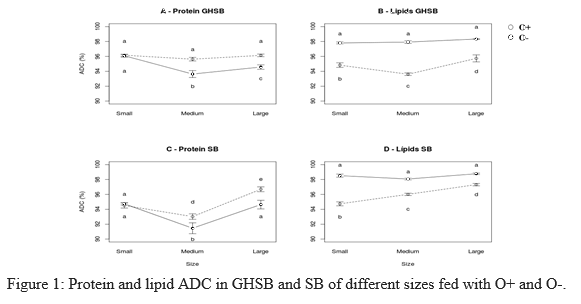
There are significant difference in protein digestibility obtained for the two methods of analysis (AIA and CF) in GHSB (P <0.001) and SB (P <0.05). For lipids digestibility in GHSB there are also significant differences (P <0.001) but not in SB. The CF method reported digestibility values for proteins and lipids significantly higher than the method of AIA, and also more precise. After evaluating the analytical procedures (more precise and less time consuming for CF) and reviewing the specific literature (Hillestad et al., 1999; Morales et al., 1999; Krontveit et al., 2014), we choose CB for the digestibility assessment. The protein digestibility in medium and large GHSB (Fig. 1a) and SB (Fig. 1c) fed with O- was significantly higher than those fed on O+, however the small size did not show significant differences. The lipid digestibility in GHSB (Fig. 1b) and SB (Fig. 1d) tends to increase with fish size, being lower in O- than in O+.
Discussion and conclusion
The utilization of inert markers for digestibility studies in fish involves some analytical concerns because of their very low concentrations in feed and faeces. This is particularly pronounced when using AIA because its concentration is very low and it is required an extremely fine weighing. Nevertheless, CF content in fish feed is slightly higher than the AIA content as a result of the increasing utilization of vegetal raw materials, and then the analytical error is lower which favour a higher precision. A great precision does not always involve a great accuracy so comparisons between studies only must be done when both use the same marker. The origin of raw materials may determine differences in the nutrients digestibility (Hillestad et al., 1999). O+ feedstuffs use by-product from fisheries and aquaculture and these seem to provide lipids of a greater quality but proteins of worst condition than O-, especially for medium and large fish sizes. The lower lipid digestibility observed for O- may be due to the lower inclusion of fish oil than in O+. The lower protein digestibility obtained with O+ could be related with the meals quality, and with the restrictions imposed by the organic aquaculture regulation.
References
Hillestad M., Åsgård T., Berge G. M., 1999. Determination of digestibility of commercial salmon feeds. Aquaculture 179, 81-94pp.
Krontveit R. I., Bendiksen E. Å., Aunsmo A., 2014. Field monitoring of feed digestibility in Atlantic salmon farming using crude fiber as an inert marker, Aquaculture 426-427, 249-255pp.
Morales A. E., Cardenete G., Sanz A., Higuera M., 1999. Re-evaluation of crude fibre and acid-insoluble ash as inert markers, alternative to chromic oxide, in digestibility studies with rainbow trout (Oncorhynchus mykiss), Aquaculture, 179: 71-79pp.
Acknowledgments
This study was funded by the Spanish Institute of Agrarian Research (INIA): RTA2011-00088-00-00, Ministry of Economy and Competitiveness, and by FPI-INIA grants.