TRANSGENIC CAMELINA SATIVA AS A SOURCE OF OILS TO REPLACE MARINE FISH OIL IN AQUACULTURE FEEDS
Introduction
Marine fish oils are a finite and limited resource and the use of high levels in aquafeeds is a non-sustainable practice (Tocher, 2015). Alternative oils sourced from terrestrial plants do not contain long-chain polyunsaturated fatty acids (LC-PUFA), therefore, feeds based on conventional vegetable oils reduce levels of eicosapentaenoic acid (EPA) and docosahexaenoic acid (DHA) in farmed fish (Turchini et al., 2010). Consequently, the aquaculture industry requires new oil sources that contain high levels of n-3 LC-PUFA to supply the increasing demand for fish and seafood while maintaining the high nutritional quality of farmed products. One viable approach to the renewable supply of n-3 LC-PUFA is metabolic engineering oilseed crops with the capacity to synthesize these critical fatty acids (Sayanova and Napier, 2011). Recently, the oilseed Camelina sativa has been transformed with algal genes encoding the n-3 biosynthetic pathway and expression restricted to the seeds via seed-specific promoters to produce oils containing either EPA alone or EPA and DHA (Ruiz-Lopez et al., 2014). These oils were investigated as replacements for marine fish oil in feeds for Atlantic salmon (Salmo salar) and gilthead sea bream (Sparus aurata). In addition to assessing the ability of the novel oils to maintain the nutritional quality of farmed fish, these studies have contributed to our understanding of the biochemical and molecular mechanisms involved in the control and regulation of DHA production from EPA, and thus better inform our understanding of the LC-PUFA biosynthetic pathway in salmonids and marine fish species.
Materials and Methods
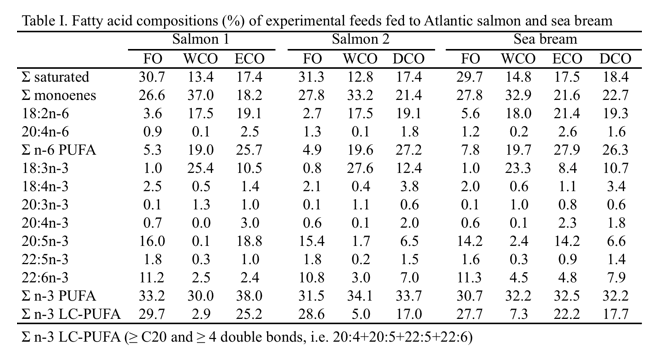
Isonitrogenous and isoenergetic diets were formulated to satisfy the nutritional requirements of salmon and sea bream (NRC, 2011). The diets for salmon supplied 45-46 g.kg-1 crude protein and 21-25 g.kg-1 crude lipid (depending upon trial), and the sea bream diets supplied 50 g.kg-1 crude protein and 17 g.kg-1 crude lipid and were manufactured at BioMar Tech-Centre (Brande, Denmark). For each species, the diets had the same basal composition with added oil supplied by fish oil (FO), wild-type Camelina oil (WCO) or EPA-Camelina oil (ECO) or EPA/DHA-Camelina oil (DCO). The fatty acid compositions of the feeds are shown in Table 1. Non-defatted fishmeal was employed as the major protein source to ensure EFA requirements were met. Ytrium oxide was added to the experimental diets (0.5 g kg-1) as an inert marker for calculation of lipid and fatty acid digestibility. For the Atlantic salmon trials, post-smolts were distributed into seawater tanks (45 fish per tank) and fed the three experimental feeds in triplicate for 7-8 weeks. The experimental system comprised 1 m2, 500 L tanks supplied by flow-through seawater (15 L min-1) at ambient temperature that averaged 10.2 ± 0.6 °C. Similarly, sea bream of initial size 50 g were distributed into 12 x 1000 L tanks (35 fish per tank) supplied by flow-through filtered seawater at an ambient temperature of 19.5 °C and fed the four experimental feeds in triplicate for 12 weeks. Prior to the initiation of the feeding trials, all fish were acclimated for 1 week during which time they were fed the WCO diet. For salmon, feeds were delivered in excess by automatic disc feeders with an automated uneaten feed collection system. For sea bream, feeds were delivered by hand to satiety twice daily. Growth performance, feed efficiency and fish health were determined along with nutrient and fatty acid composition. In addition, the metabolic/molecular consequences of this new ingredient were assessed by analysis of gene expression using oligonucleotide microarray and/or quantitative RT-PCR.
Results and Discussion
There is a global lack of the n-3 LC-PUFA, EPA and DHA, to satisfy current human dietary requirements (Tocher, 2015). As fish and seafood are the main sources of these critical nutrients in the human diet, and as the majority is now farmed, there is pressure on aquaculture to maintain the health-promoting benefits of the farmed products. Entirely new sources of n-3 LC-PUFA are required and, currently, oils from transgenic oilseed crops represent the only feasible option that can supply the volumes of EPA- and DHA-rich oil at a likely cost that animal production can afford. The results of the present studies will demonstrate that oils derived from transgenic oilseed crops are effective, safe replacements for marine fish oils in aquaculture feeds that can maintain high levels of n-3 LC-PUFA.
Acknowledgments
MBB and this project were partly funded by a UK Biotechnology and Biological Sciences Research Council (BBSRC) Industrial Partnership Award (BB/J001252/1). The sea bream trial was partly supported by a Trans-National Access grant (0119/08/12/28) from the EU FP7 CP-CSA Project 262336 Aquaculture infrastructures for excellence in European fish research (AQUAEXCEL), and a Santander University Staff Mobility Fund award.
References
National Research Council (NRC), 2011. Nutrient requirements of fish and shrimp. The National Academies Press, Washington D.C.
Ruiz-Lopez, N., R.P. Haslam, J.A. Napier, O. Sayanova. 2014. Successful high-level accumulation of fish oil omega-3 long-chain polyunsaturated fatty acids in a transgenic oilseed crop. The Plant Journal 77: 198-208.
Sayanova, O., J.A. Napier. 2011. Transgenic oilseed crops as an alternative to fish oils. Prostaglandins, Leukotrienes and Essential Fatty Acids 85: 253-260.
Tocher, D.R. 2015. Omega-3 long-chain polyunsaturated fatty acids and aquaculture in perspective. Aquaculture, in press (doi.org/10.1016/j.aquaculture.2015.01.010).
Turchini, G.M., W.-K. Ng, D.R. Tocher. (Eds.) 2010. Fish Oil Replacement and Alternative Lipid Sources in Aquaculture Feeds. Taylor & Francis, CRC Press, Boca Raton. 533p.