TAMBAQUI, Colossoma macropomum, SEEMS TO HAVE LIMITED ABILITY TO DIGEST PHOSPHORUS FROM DICALCIUM PHOSPHATE AND ANIMAL PROTEIN SOURCESa
Introduction
Phosphorus (P) is an important nutrient in aquaculture feeds mainly to its potential to determine the sustainability of fish farm. It is well known that several factors affect P utilization by fish, e.g. P source, growth stage, rearing system, the type of commensal microbiota, fish species etc. Therefore, studies on P requirement and utilization of this nutrient in different sources are mandatory for the sustainable growth of any aquacultured species. Tambaqui is a fast-growing Neotropical freshwater fish with great economical and social importance for Latin American countries, with emphasis to Brazil. However, there are limited studies on P nutrition for this species and its phylogenetic group. In previous studies, we have observed that P requirement for tambaqui juveniles is markedly low, compared to other fish species and they may have the ability to efficiently use phytate-P from vegetable sources; however, we did not evaluate the ability of tambaqui to digest inorganic and organic P sources commonly used by aquafeed industry. Therefore, we aimed to determine apparent digestibility coefficients of P in different inorganic and organic P sources used in fish feeds. Additionally, we performed a second trial to test whether the microbiota or the endogenous enzyme production were responsible for the high P digestibility in vegetable sources.
Materials and methods
A hundred and thirty-five market-size tambaqui (1.005 ± 0.042kg) were randomly assigned to 15 500L-aquaria connected to a recirculating system and following a completely randomized design with five treatments and three replicates. Treatments consisted of five dietary ractopamine levels (0, 2.5, 5.0, 10.0, and 20.0 ppm). Proximate composition of the diets was similar for all nutrients. Fish were fed ad libitum two times a day. After 30 days, three fish per tank were anesthetized with eugenol, bled by caudal punction and the liver removed for determination of serum metabolites (cholesterol, triacylglycerol, albumin, total serum protein and globulin) and ALT (alanine aminotransferase) and AST (aspartate aminotransferase) activities, respectively. Results were submitted to ANOVA and when significant (P<0.05), regression or Duncan's multiple range test were used to compare the results.
Results
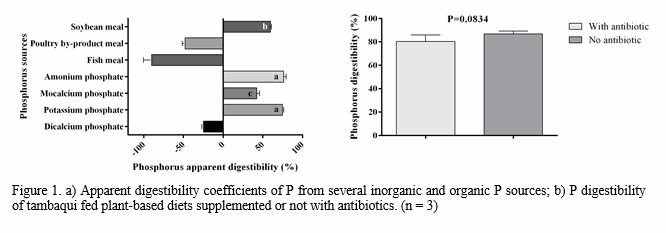
Among the inorganic P sources, potassium and ammonium phosphate showed the highest ADC P (74.77 and 76.25%, respectively) while dicalcium phosphate had the lowest (and negative) P digestibility (P<0.001) (Fig. 1a). Monocalcium phosphate was fairly well digested by tambaqui (42.35%) while animal protein sources (FM and PBM) had a markedly low P digestibility. SBM showed relatively high ADC P (59.74%), which were significantly higher monocalcium phosphate and all animal protein sources (P<0.001).
Antibiotic treated-fish fed a plant-based diet showed similar ADC P compared to untreated fish (80.39 and 86.75%, respectively) (P>0.05). However, the ADC P for both diets were generally.
Discussion and conclusion
Our results showed that tambaqui is able to efficiently digest the most common inorganic P sources. However, Dicalcium phosphate seems not be digested or is poorly digested by tambaqui. Furthermore, animal protein sources seems to be poorly digested as well by tambaqui. Although in a previous pilot study, we have observed similar results but even higher than those, we have observed the same trend of the animal protein sources. These differences are difficult to explain since the diets were formulated to present the same P and Ca levels. Nevertheless, we cannot ruled out a possible analytical error due to the limited amount of sample to perform the analysis. The high P ADC observed for SBM have been observed previously in our study and could be related to ability of tambaqui to digest phytate-P. Although few results with other species have been reported, we cannot ruled out this hypothesis since there are evidences that some fish species are able to digest phytate-P by gut phytase production endogenously and/or by commensal microbiota. However, this may not be the case for tambaqui, since when fish were treated with antibiotic just a small reduction on P digestibility was observed, but this was not significantly. Additionally, fish size and faeces collection stress may have affected commensal bacteria levels, and thus, a proeminent effect could not be observed.
In sum, our results demonstrated that ractopamine has limited effects on increasing protein metabolism and inducing lipolysis in tambaqui by using some indirect serum metabolites.
References
Adeola, O., McBride, B. W., & Young, L. G. 1992. Metabolic responses induced by isoproterenol in ractopamine-fed pigs. The Journal of nutrition, 122(6): 1280-1286.