EFFECT OF SUPPLEMENTATION OF LACTOBACILLI ON GROWTH AND MICROBIOTA COMPOSITION IN JUVENILE PIKE-PERCH Sander lucioperca REARED IN INTENSIVE SYSTEM
Introduction
Pike-perch (Sander lucioperca) is a freshwater teleost fish commercially significant for European aquaculture and fisheries. Maintaining of its larviculture in Recirculating Aquaculture System (RAS) is rather challenging due to low stress resistance, cannibalism and, consequentially, low survival in larval stage (Steenfeldt, 2015). Still, intensive larval rearing of pikeperch is not possible without supply of live food. However, live food supply stands for the majority of costs of juvenile production, numerous efforts are put towards partial replacement of live food with artificial formulated diet (Ljubobratović et al. 2015). From other side, artificial feed contains high amounts of non-soluble proteins (García-Ortega and Hulsman 2001). Thus, larvae development is impeded when feeding on formulated diet. Solution to improve pikeperch larviculture in RAS could lay in probiotics. Bacterial groups commonly used as probiotics in aquaculture belong to Pseudomonas, Bacillus spp. and Lactic Acid Bacteria (LAB). Lactobacilli are most frequently used LAB probiotics (Mertinez Cruz et al. 2012) to elevate digestive enzyme activity in fish gut. Moreover, frequent problem encountered by fish breeders in RAS are opportunistic infections, a common problem among farmed fish, due to high fish crowding and stress. There were several attempts to shift the composition of fish microbiota from facultative pathogenic members to less virulent LAB. (Leroi and Joffraud 2011) The aim of this research was to test the effects of lactobacilli, applied to pike-perch larvae, either through hydrolyzed OTOHIME fish diet, or through Artemia nauplii, on fish growth, microbiota balance and skeletal development.
Materials and methods
Twelfth Days Post Hatching (DPH) larvae were divided into different treatment groups: two groups received the combination of OTOHIME and nauplii enriched either with Lactobacillus paracasei BGHN14 + Lactobacillus rhamnosus BGT10 or with Lactobacillus reuteri BGGO6-55 + Lactobacillus salivarius BGHO1, and one group received OTOHIME hydrolyzed by BGHN14+BGT10 and non-enriched nauplii. Lb. salivarius BGHO1 was shown to possess strong immune stimulating potential, while Lb. reuteri strains are known to produce reuterin, which possesses high antimicrobial potential. Lb. paracasei and Lb. rhamnosus were previously shown to possess proteolytic activities Control group received non-enriched nauplii and non-hydrolyzed OTOHIME. The treatment lasted 14 days and on the 26th DPH fish were sampled for: morphometric evaluations of length and weight, RNA isolation and biochemical assays and for histological analysis. For the evaluation of long term effects of treatments, fish were further reared in original setup for additional three weeks and survival, individual total body length and weight, as well as skeletal deformities in fish with inflated swim bladder, were assessed on the 45th DPH. In both time points (26th and 45th DPH), swim bladder inflated (SBI) and swim bladder non-inflated (SBNI) fish were analyzed and sampled separately.
Results
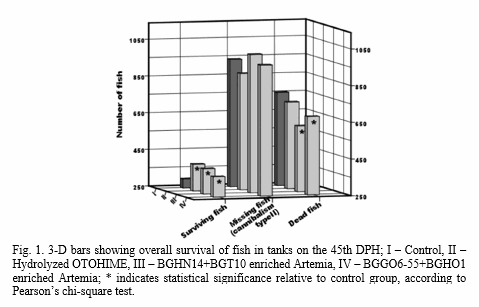
Our results showed beneficial effects of Lb. reuteri BGGO6-55 + Lb. salivarius BGHO1, when supplemented to larval pike-perch through Artemia nauplii, on fish growth, skeletal development and trypsin to chymotrypsin activity ratio (T/C), as an indicator of protein digestibility (Figure 1). A positive influence of Lb. paracasei BGHN14 + Lb. rhamnosus BGT10 hydrolyzed OTOHIME fish diet was noticed on fish survival, protein digestibility, reduction of skeletal deformities and reduction of levels of potential pathogens.
Discussion and conclusion
The results of this pioneer study is showing that supplementation of lactobacilli in larval pikeperch has positive effects on larval growth, protein digestibility and skeletal development. Additionally, it was demonstrated that larvae fed OTOHIME hydrolyzed by lactobacilli exhibited improved protein digestibility and skeletal development and also prevented the growth of potentially pathogenic bacteria. Our further research will be directed towards the optimization of the process for economic large-scale production of cultured pike-perch and, importantly, reduction of opportunistic pathogen load, which will ensure the safety of pike-perch cultivation from both ecological and human health perspective.
References
García-Ortega A, Hulsman EA. 2001. Evaluation of protein quality in microbound starter diets made with decapsulated cysts of Artemia and fishmeal for fish larvae. J World Aquac Soc. 32:3.
Leroi F, Joffraud JJ. 2011. Microbial degradation of seafood. Montet D, Ramesh C. Ray RC, editors. Aquaculture microbiology and biotechnology. Boca Raton, FL, US: CRC Press Taylor & Francis Group
Ljubobratović U, Balázs Kucska B, Feledi T, Poleksić V, Marković Z, Lenhardt M, Peteri A, Kumar S, Rónyai A. 2015. Effect of weaning strategies on growth and survival of pikeperch, Sander lucioperca, larvae. Turk J Fish Aquat Sci.15:325-331
Martínez Cruz P, Ibáñez AL, Monroy Hermosillo OA, Ramírez Saad HC. 2012. Use of probiotics in aquaculture. ISRN Microbiol. 2012:916845.
Steenfeldt S. 2015. Culture methods of pikeperch early life stages. Kestemnot P, Dabrowski K, Summerfelt RC, editors. Biology and Culture of Percid Fishes: Principles and Practices. Dordrecht, Netherlands: Springer Sciences+Business Media